What's the Threshold? An ADHD Motivation Guide to Getting Your Foot in the Door
What’s the Foot-in-the-door? What's the Threshold?
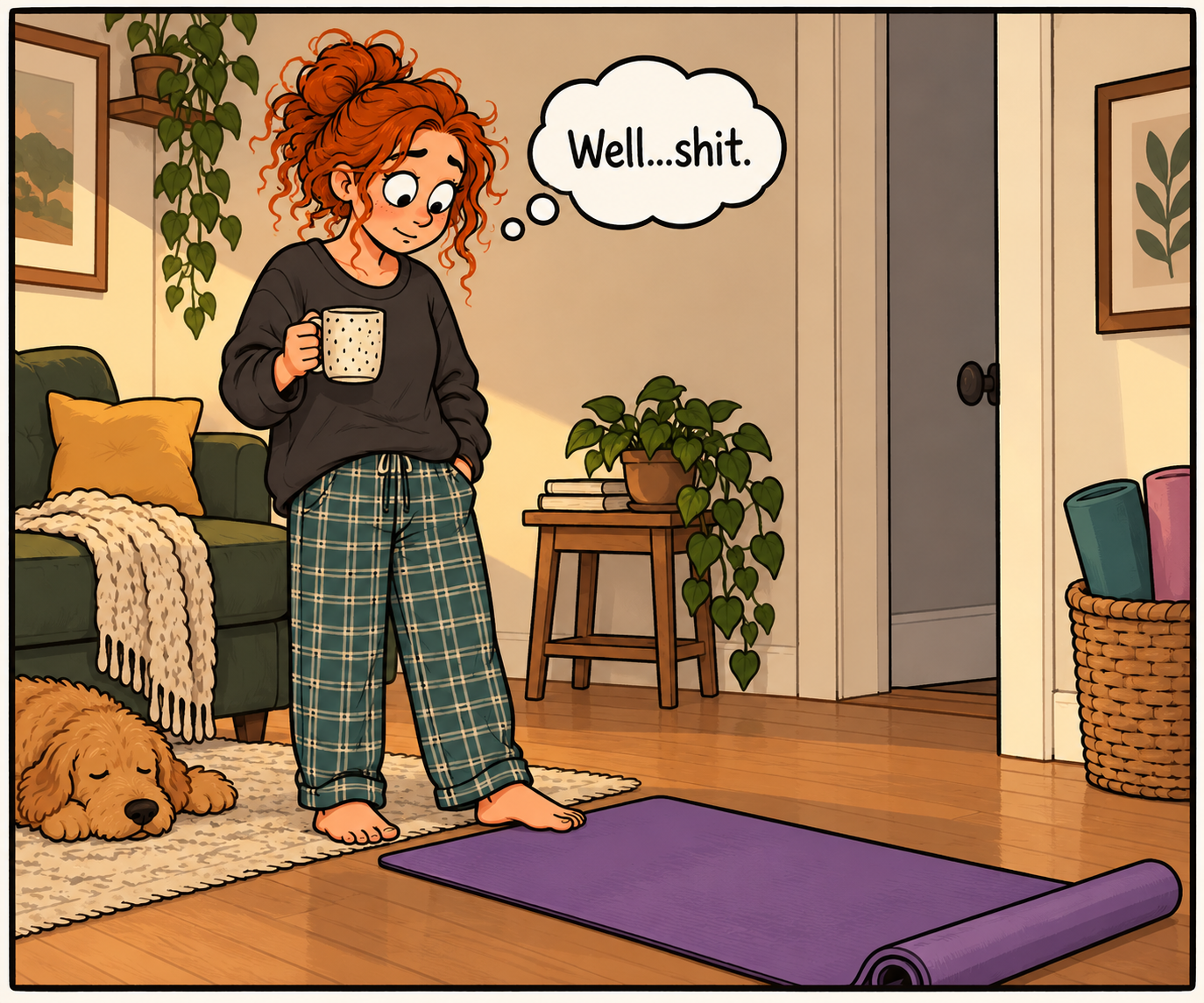
I was talking with a neurodivergent client recently about her desire to exercise. She was saying she knows she needs to move her body more. In fact she actually wants to move her body more, specifically through yoga. She has a yoga mat. She knows what to do. None of this is new information. But when it comes to actually “pulling the trigger” on doing the yoga, it feels like such a chore just to get the mat out. Whatever it is, the way you tell your story online can make all the difference.
So I submitted: “Okay. Then just leave the yoga mat out.” Seriously. Why are we putting it away?
If getting the yoga mat out is the pain-in-the-ass step standing between you and actually using it, just leave the damn yoga mat out in the floor.
This is something I do constantly with my own ADHD, I notice the part that feels the hardest, or is the main obstacle between me and getting the task done; I call that the Threshold; the barrier between me and walking through the door of what I need to get done. Once I have that figured out, I look for ways to ease that part of the task, to lower the threshold. Looking at this as a Threshold rather than the age-old ADHD mantra, “why can’t I just be motivated?” changes the perspective, and can actually ease the burden and the shame. And listen, I am sure that implicit-“just do it”-motivation works just fine for plenty of people, but the average ND person just wasn’t blessed with that stuff. So we pivot.
Once you start looking for your own thresholds, you can apply this spin to all kinds of things. I think of it as getting my foot in the door.
You Don't Need Enough Motivation to Finish
There were so many times before I found out I was in fact ADHD where I would tell myself, I can’t start that project because I can’t work on it all day long. Then I started to see the pattern of either I wouldn’t do the thing, and be pissed at myself for it, OR I would go too hard on it and burnout and end up right back where I started. Something pretty much ANY ADHD client of mine will tell you is I talk A LOT about finding the “medium place” in a task you lay out for yourself. The medium place between not doing it at all and doing it too hard is where the magic happens! So, no, you do not have to have the motivation to start and finish the thing, whatever that is for you, you just need to find a spot that feels like more than nothing and less than everything.

When writing papers in college, the medium place would be finding scholarly articles and putting together my bibliography page, and NOT tackling the entire thing start to finish, and NOT putting it all off till the last minute. EASY. The medium place in home projects/chores might be, I HATE putting my clothes away, but there are some that are easier than others so I do those at the very least. EASY. It’s not living out of a laundry basket for a month, and it’s not taking hours to reorganize my closet. Although, there are those times where just getting myself in the medium place of a task, gets me the momentum I need to complete it.
I've written before about the fact that ADHD motivation doesn't always work the way we've been taught motivation is supposed to work. In You're Not Lazy: ADHD Motivation and Executive Dysfunction, I talked about why starting can be so damn hard, even when we care about the thing we're trying to do.
Sometimes we wait around for enough motivation to complete a task. I need enough energy to work out. I need enough motivation to clean the kitchen. I need enough focus to finish my notes. I need enough time to clean the whole bedroom.
But what if you just don't have enough?
What if you only need enough motivation to get your foot in the door? Not enough to finish. Enough to begin. Enough to make the next step a little easier. Enough to shorten the distance between where you are and where you're trying to go.
The Actual Foot-in-the-Door
There's actually an old social psychology experiment that I think about all the time when I'm explaining this Foot-in-the-Door concept.
In 1966, researchers Jonathan Freedman and Scott Fraser published a study on what became known as the foot-in-the-door technique. Though their research wasn't about ADHD or executive functioning, I still think the principle and imagery here are applicable to how ADHD folks can tackle motivation issues. They were studying compliance: whether agreeing to a small request made someone more likely to agree to a larger request later.
In one of their experiments, homeowners were eventually asked to allow a large, unattractive safe-driving sign to be installed in their yard alongside the road. People who had previously agreed to a much smaller related request were considerably more likely to agree to the big one. Whereas the people who never agreed to the small request, were far less likely to agree to this larger one.
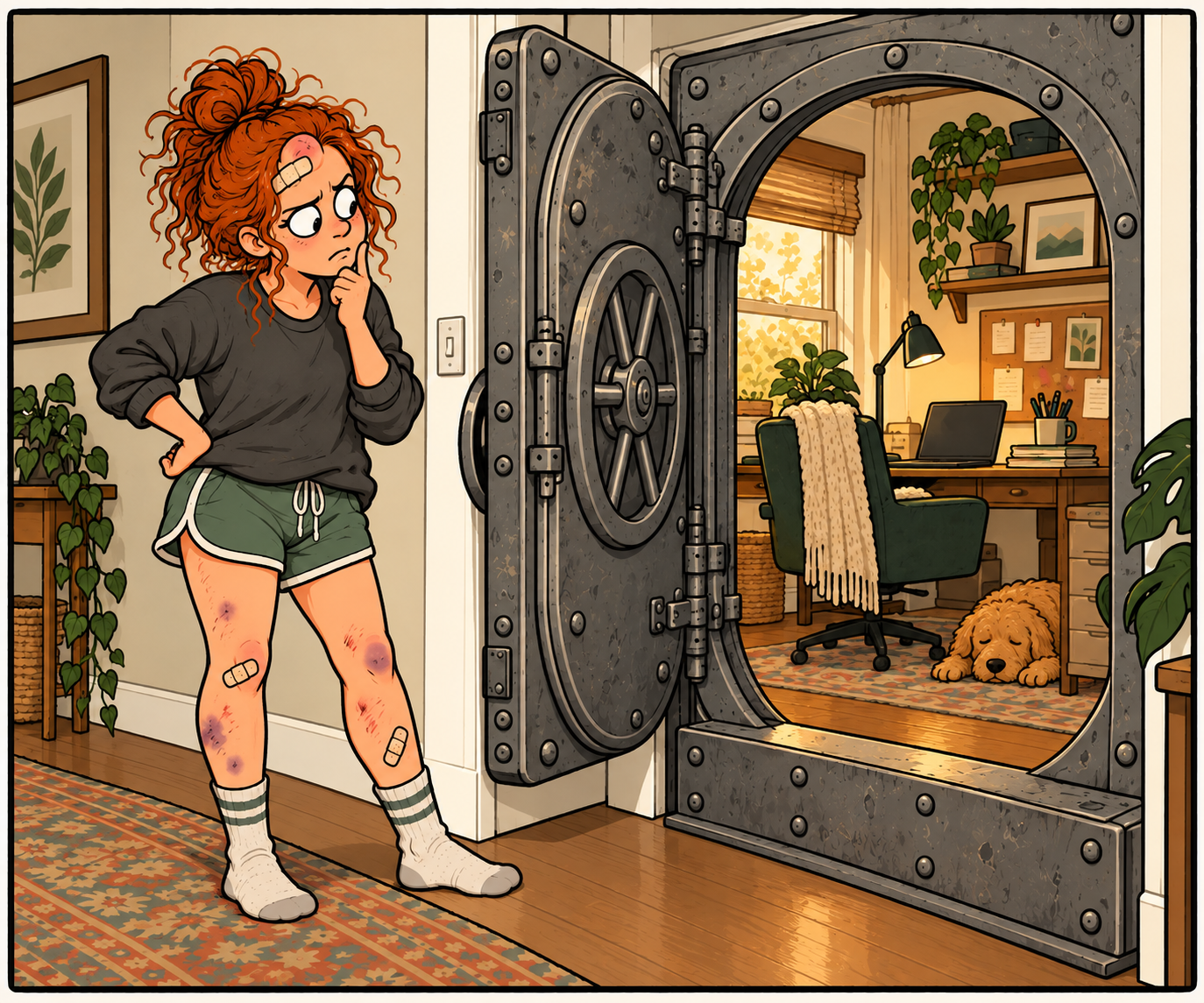
Again, this was a study of interpersonal compliance, not ADHD. But I have borrowed the hell out of the idea. Because what happens if instead of using the foot-in-the-door technique on somebody else, I use it on myself?
I ask myself: What is the smallest thing I can agree to that gets me partially inside the task?
Find the Threshold
This is where I think the word threshold is useful in two different ways.
First, there is the threshold that's tripping you up. Where, exactly, does this task become difficult? “Exercise” might not actually be the problem. Maybe it's changing clothes. Maybe it's finding the yoga mat. Maybe it's choosing a workout. Maybe it’s finding matching socks in your sock basket. Maybe it's getting your shoes on. Maybe it's leaving the house. Maybe you genuinely enjoy yourself once you're at the gym. It's everything between couch and gym that's screwing you up.
So instead of asking:
“Why can't I make myself exercise?”
Try:
“At what exact point does this become hard to start?”
Then there's the other kind of threshold: the doorway. What's the smallest thing you can do to get one foot across it? You don't have to get all the way inside. Just get your foot in the door.

Building Slides Instead of Cliffs
This is something I talk about frequently when I'm working with parents of ADHD and other neurodivergent kids, too. In Parenting a Dopamine-Seeking Kid Without Crushing Their Spirit, I talk about creating slides instead of cliffs for difficult tasks, transitions, etc.
Sometimes the transition between what we're currently doing and what we're supposed to do next is too abrupt.
We're asking the brain to jump from:
Couch → WORK OUT.
That's a cliff. So build a slide.
Maybe the slide is:
Couch → put on workout clothes → see how I feel.
Or:
Home → drive to the gym parking lot → decide whether I'm going inside.
Or:
Yoga mat in closet → yoga mat already sitting on the floor → maybe I'll get on it.
We do this for kids because we understand that transitions are hard. It’s complete bullshit to think that adults should just magically stop needing that. We don't. I need slides too, and I’m not afraid to admit it!
Go to the Gym Parking Lot
The same client I spoke of earlier told me about something she'd seen someone else suggest along the same lines I had mentioned to her:
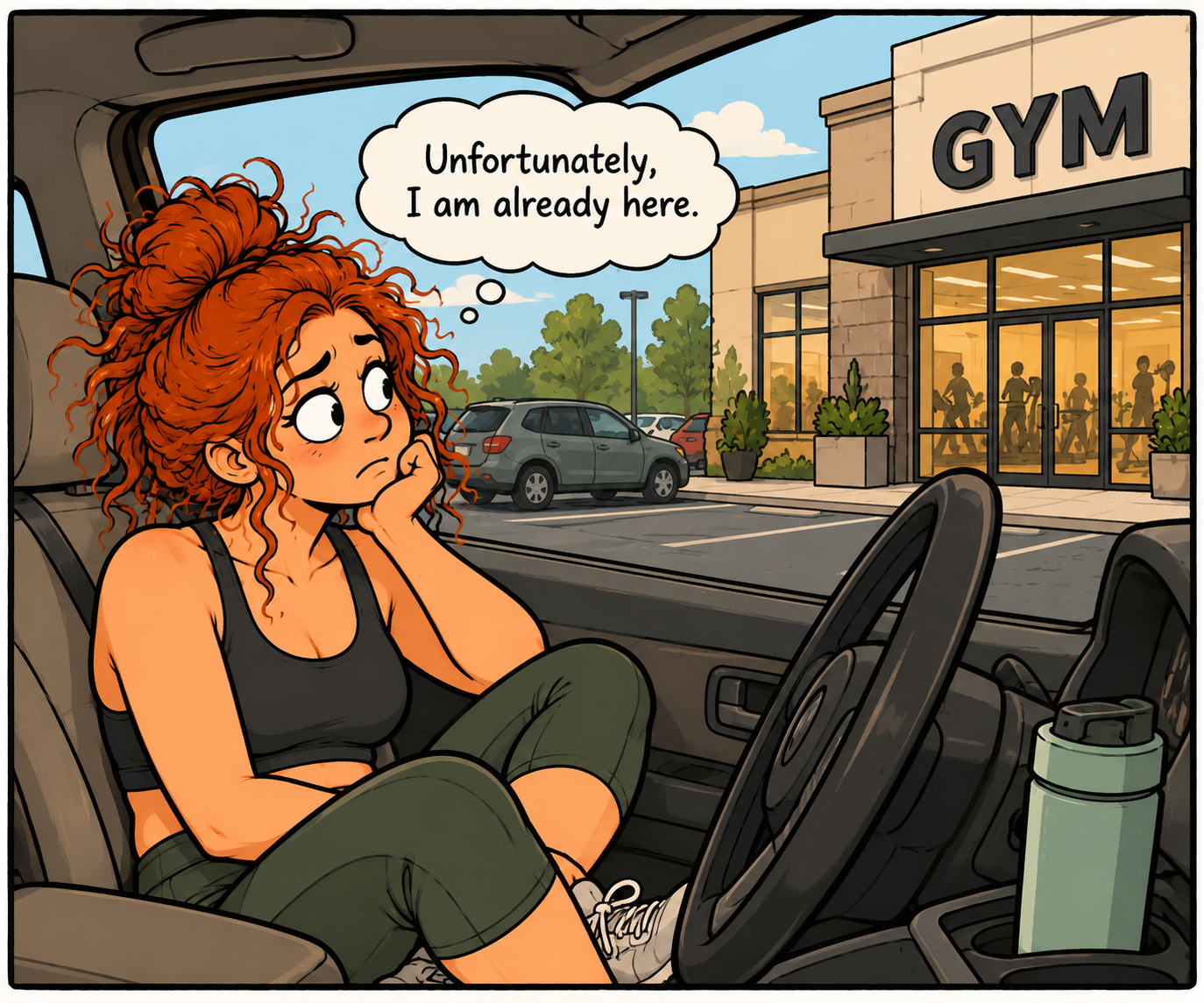
Don't tell yourself you have to go to the gym. Tell yourself you have to go to the gym parking lot.
That's it. Drive there. Once you're sitting in the parking lot, you can decide whether you want to go inside.
I LOVE this.
Because once I'm already there, going inside suddenly feels a whole lot easier than it did when I was sitting at home. But there's another part of this that matters enormously to me: I still have an out.
If I get to the gym parking lot and think, Absolutely fucking not, I can leave. And I really mean that.
I think that's especially important for those of us with a PDA-ish relationship with demands. There is a huge difference between:
“I HAVE to go work out” and “I'm going to drive over there and then I'll decide.”
One is a demand. The other is a choice.
And weirdly enough, knowing that I can say no often makes it easier for me to say yes. If I decide to walk into the gym, I chose that. If I drive home instead, apparently I just didn't have it in me today. No worries. an important note here is this: The strategy only works if the exit is real. Otherwise your brain may eventually figure out that “just drive to the parking lot” is a hostage negotiation and stops falling for it and we are back to square one again.
Get Tomorrow's Foot in the Door Today
I also think ADHD night owls have a particular opportunity here. If in assessing your bandwidth you realize you make yourself big promises for what’s gonna go down tomorrow, but tomorrow comes and there’s not execution, we need to restructure! If Evening You has energy and Morning You wakes up wondering who authorized consciousness, stop assigning Morning You all the setup work.
Use the energy when you have it.
Set out your clothes. Fill your water bottle. Put the thing you need to remember in front of the door. Pack your bag. Open the document you're going to need tomorrow. Put your medication somewhere you'll encounter it as part of your morning routine. Leave the yoga mat out.
When I was doing my best with exercising regularly, I was still a stay-at-home mom, which certainly made some things easier. But one of the things that worked really well for me was ridiculously simple:
I got dressed in exercise clothes every morning as soon as I got out of bed. That was it.
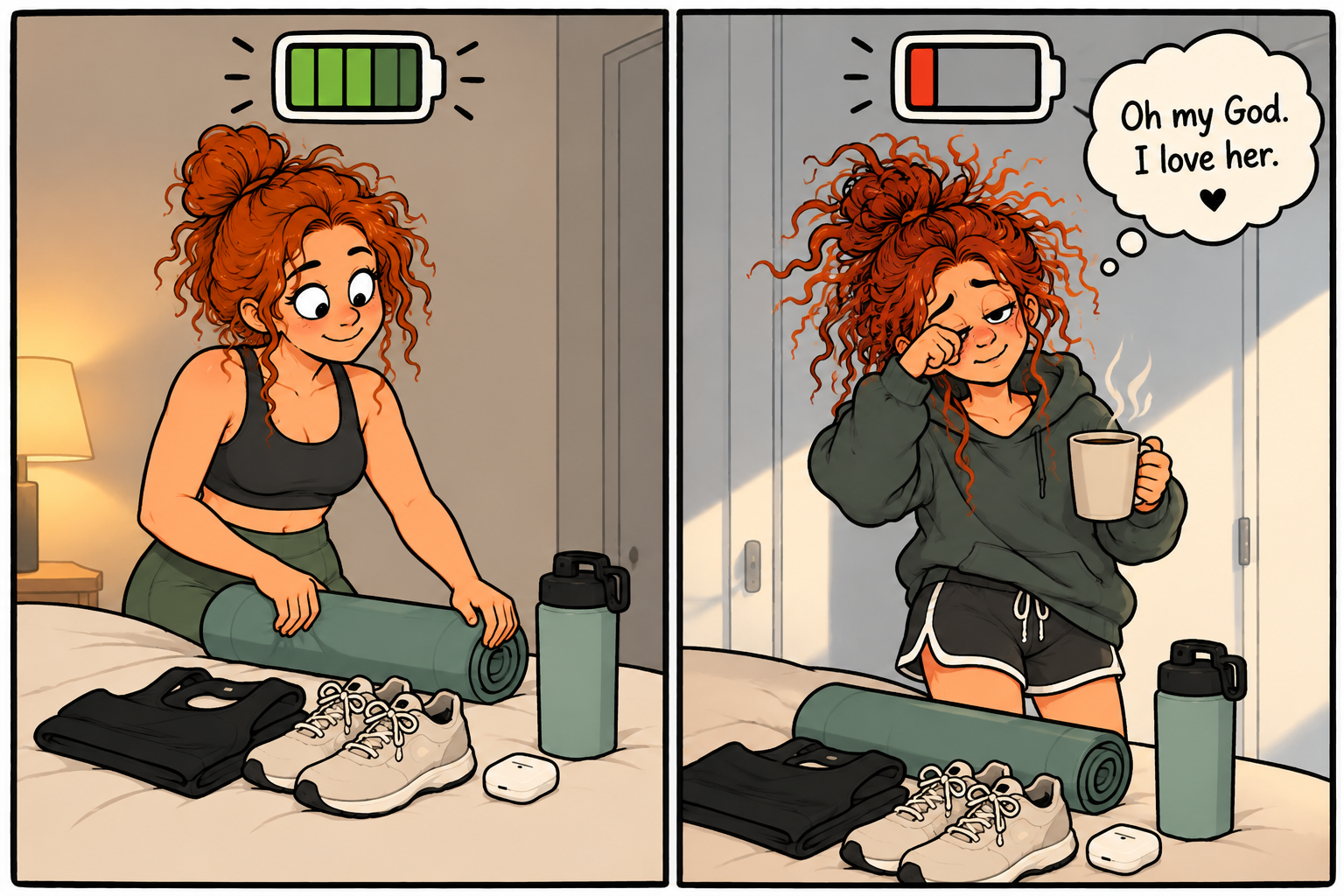
I didn't promise myself I would exercise. I just got dressed for the possibility of exercising. Once I was already wearing the clothes, though?
Well, shit.
I had one foot in the door. More often than not, I ended up moving my body. And if I didn't? I was wearing cute stretchy pants. There are worse outcomes.
Design for the Person You Actually Are
This threshold idea is also how I think about ADHD organization.
If you're constantly losing something (keys, phone, batteries, medication, etc.), before you put it away,
Don't ask: “Where should this go?”
Instead ask: “When I need this later, where am I going to look for it?”
And THAT is where it goes!
So what if that's not where a professional organizer would put it? Who cares? The professional organizer does not live in your house. But Future You does, and they are are gonna be the one looking all over for it, save them the trouble!
We're often trying to build systems around the imaginary version of ourselves who will definitely remember that the AA batteries are in a beautifully labeled bin on the third shelf of the hall closet, and the 9V are in the dumb-shit-drawer, and lord knows where the button batteries went. (Side note, and not an ad, but I cannot TELL you what a godsend having a Battery Daddy is for this issue! highly recommend!)
Meanwhile, six months from now, Actual You is standing in the junk drawer yelling, “WHERE THE HELL ARE THE BATTERIES?” Put them where Future You will look. Stop building systems for the person you think you should be. Start leaving breadcrumbs for the person you actually are. Lower the threshold; you aren’t living in a submarine; this is your own home!
Keep Your Shoes On
I've heard a number of ADHD people say they keep their shoes on when they get home if they still need to accomplish things.
But trust that I can already hear some of you…. “EW! SHOES IN THE HOUSE?!” I can hear the gasp some of you gusped. Fine. Then try indoor shoes. Slippers. Whatever. That's not the point.
The point is that some people's brains recognize taking off their shoes as: WE ARE DONE NOW.
Shoes off. Bra off. Comfy pants on. Couch plop.
Good luck getting that train moving again. (at least without heaving sighs of frustration and “I don’t wanna!”s)
If you've noticed that about yourself, maybe you don't cross that particular threshold until you're actually ready to stop, and I totally get that. This isn't about shoes. It's about noticing the tiny environmental and behavioral cues your brain is already responding to and trying to harness them intentionally.
“I Really Don't Want To _____” Is Sometimes My Cue
I have another personal ADHD/PDA rule that sounds slightly ridiculous but works surprisingly well for me.
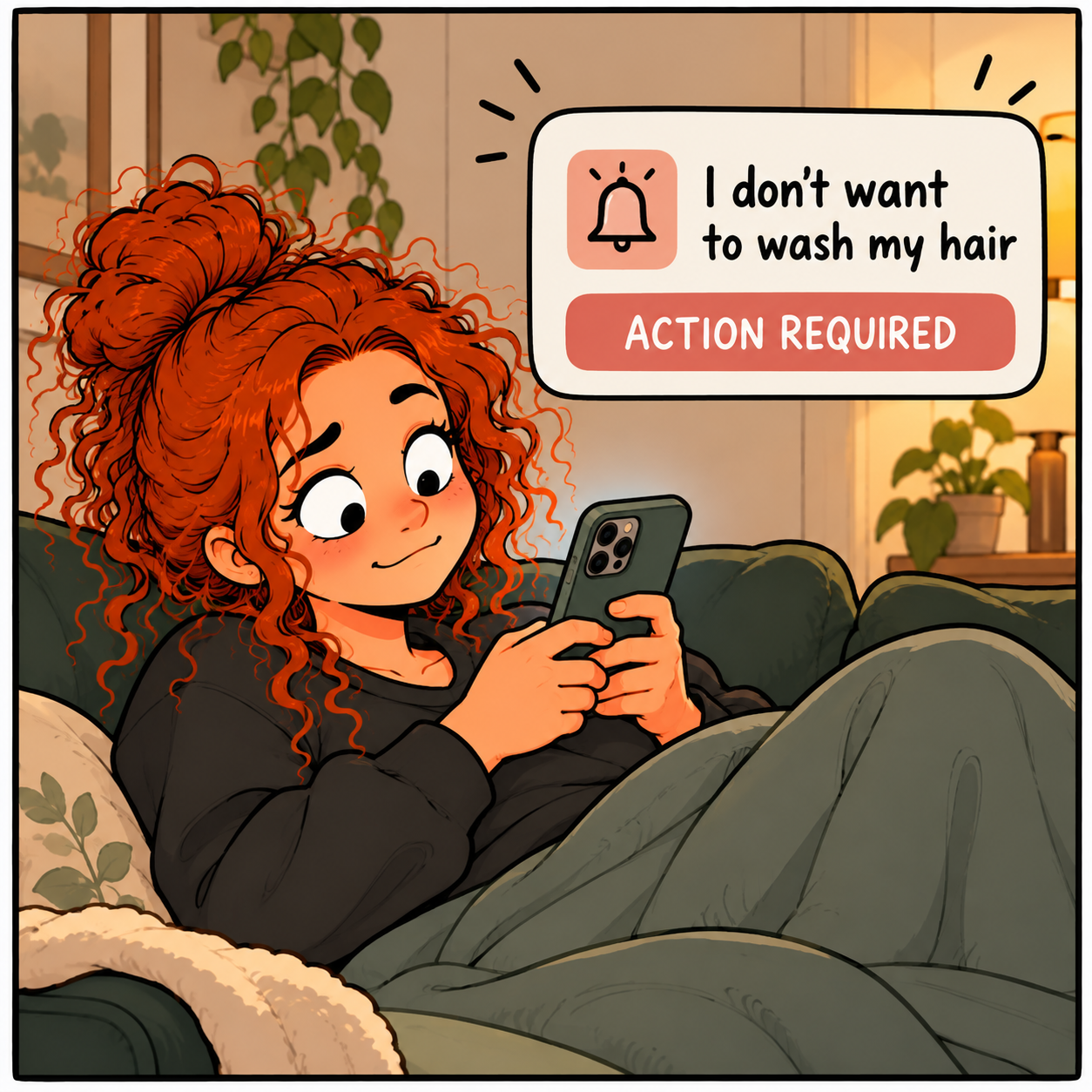
Sometimes I hear myself think: “Ugh. I really don't want to wash my hair.” Or vacuum. Or do my notes. Or whatever annoying thing is currently hovering over my head. There’s plenty of things I don’t wanna do, this list could do on and on.
But my reframe has become, if I have enough energy to actively think, I really don't want to do that, I try to immediately convert it into: “So I'm going to do it right now.”
Not always. I'm far from a robot. But I've learned that sometimes that thought is my warning notification.
🚨 Oh! We've reached the decision point.
Because if I sit around negotiating with myself for the next 45 minutes or more, or making excuses for why and how I could do it later or next week (or NEVER), I probably won't magically start wanting to wash my hair, or do any of the other dozen things I have in the open tabs in my brain. I'm just going to spend hours thinking about how much I don't want to wash my hair.
And then I still have dirty hair.
Sometimes it's easier for me to use that first little spark of resistance as the cue to move before the resistance gets to build a whole damn fortress around the demand.
But What If I Can't Finish?
Then don't.
Seriously.
This is where all-or-nothing thinking absolutely screws with ADHD brains. If I can't clean the whole kitchen, why start? If I don't have enough time for a “real” workout, why exercise? If I can't finish all my notes, why open them? If I can't deep-clean the bedroom, why pick anything up?
I get it. I have absolutely been trapped in the throes of this myself.
Especially because ADHD can come with that intoxicating BLAST OFF mode where suddenly we have energy and focus and we're going to reorganize the entire house, change our lives, establish twelve new routines, meal prep for the week, answer every email we've received since 2017, and become the person we've always known we could be.
And then... BURNOUT.
And I think in almost superstitious fashion we tell ourselves, if “I don’t have the blast off built in here, it must not be the right thing for me to do right now.” So maybe we're not looking for blast off. Maybe we're looking for traction. Give the thing a little energy.
Write one paragraph. Vacuum one room. Wash one pan. Do ten minutes. Open the note. Put five things away. Do 5 squat thrusts. Whatever!
You are allowed to stop before the task is finished. You are allowed to do something badly. You are allowed to do less than you theoretically could. You are allowed to start something without promising to hyperfixate on it until completion.
ANY Something is still more than a WHOLE LOT of Nothing.
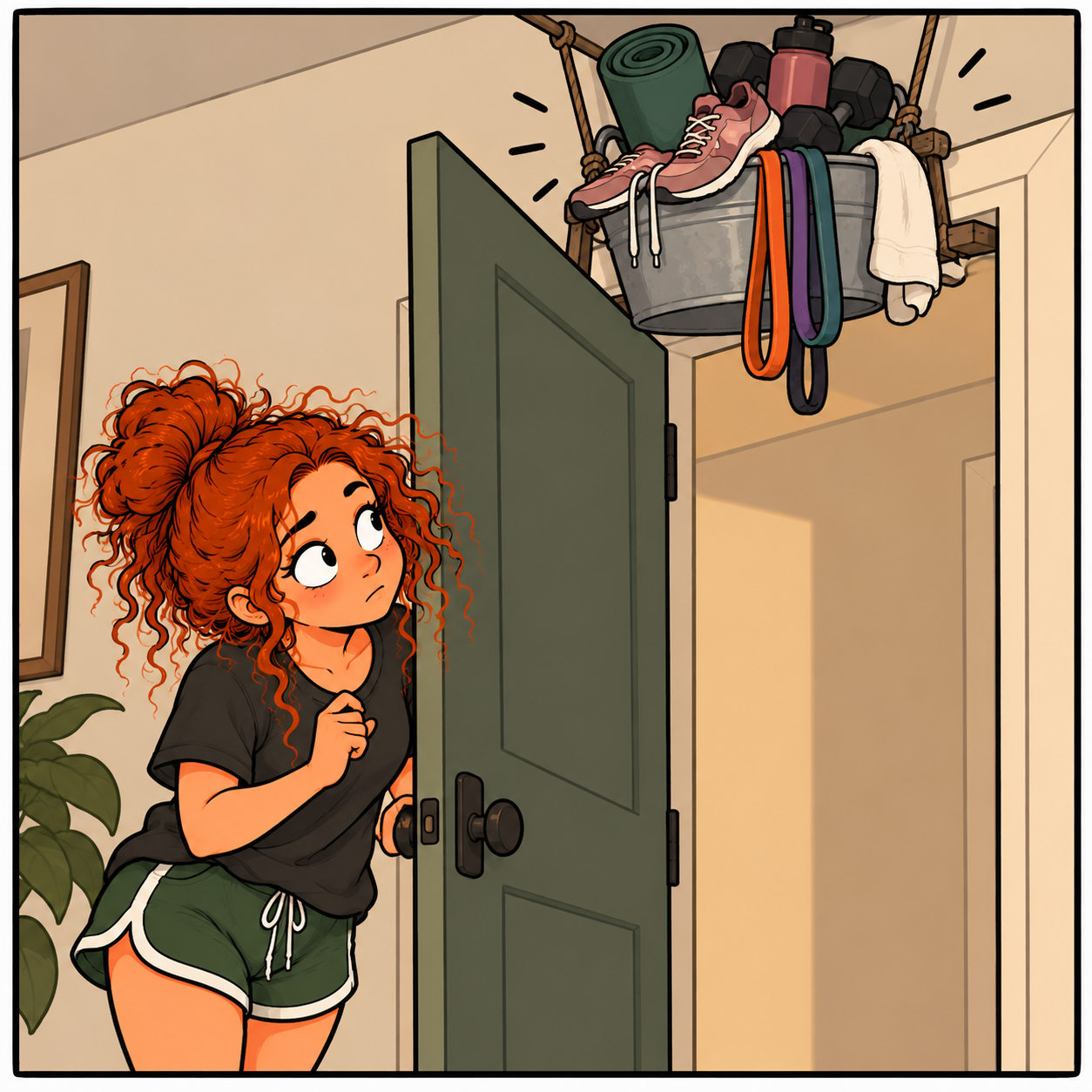
And maybe learning to tolerate that kind of partial progress helps us get out of the same old cycle of doing EVERYTHING, exhausting ourselves, avoiding the thing entirely, feeling like shit about ourselves, and eventually blasting off again.
Don't Turn the Foot in the Door Into Another Demand
This might be the most important part.
If you tell yourself: “I'm only going to open the document.”
and what you secretly mean is: “HAHA, GOTCHA, IDIOT! NOW YOU HAVE TO FINISH IT!”
Your brain is going to catch on. Especially if you're demand avoidant. Getting your foot in the door does not obligate you to walk through it.
Put the workout clothes on. You don't have to exercise. Drive to the gym. You don't have to go inside.
Open the document. You don't have to finish.
Vacuum the living room. You don't have to do the whole house.
Put the yoga mat on the floor. You don't have to use it.
Sometimes you'll stop there. That's allowed.
Because we're not trying to trick ourselves into squeezing out every available drop of productivity. We're trying to make starting safer, easier, smoother, and cheaper. We're trying to build trust with ourselves.
Shorten your Hurdles
I don't think successfully managing ADHD means becoming a person who effortlessly does all the things you've struggled to do your entire life. If you are a neurodivergent person, why—oh dear god WHY—are you holding yourself to a neurotypical standard!?
I think a lot of ADHD management is becoming really, really good at noticing yourself.
Things Like:
Where do I stall?
What transitions are hardest?
What tiny thing makes this task disproportionately annoying or overwhelming?
What do I do naturally when something does work?
Where does Future Me instinctively look for things?
When do I have energy, and how can I use some of it to help the version of me who won't?
What is the cliff here?
Where could I build a slide?
And what is the smallest step that would get my foot in the door?
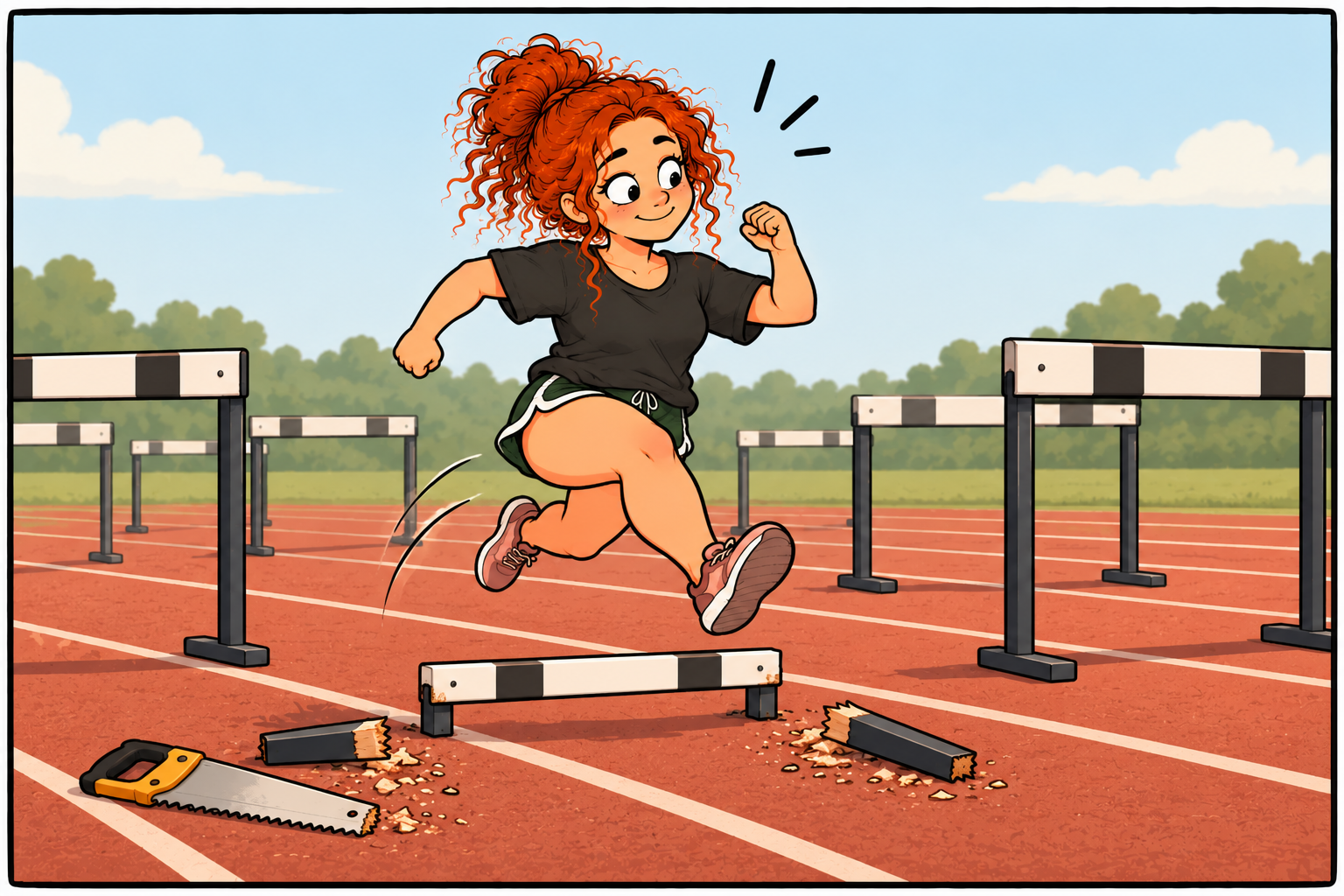
You don't have to become a person who effortlessly clears every hurdle.
You can become a person who knows where your hurdles are and makes them shorter.
Build slides where you keep finding cliffs. Leave yourself breadcrumbs. Use the energy when it's there. Give yourself an out. Let partial progress count. Get one foot in the door.
And if getting the yoga mat out is somehow the thing standing between you and actually doing yoga?
Just leave the damn yoga mat out.